


Guangdong and Thailand: Shared harvests | Guangdong Meets APEC ④
Editor's Note:The 33rd APEC Economic Leaders' Meeting will be held in Shenzhen, Guangdong Province, on November 18.
From Singapore to Sydney, from Jakarta to Bangkok, from Mexico City to Lima—Guangdong's links with APEC economies have never been just lines on a map. For 37 consecutive years, Guangdong has been Singapore's largest provincial-level trading partner in China. In Thailand, new energy vehicles made in Guangdong are entering households across the country. In Indonesia, industrial parks with Guangdong participation are helping reshape the local industrialization landscape. In Peru, the direct shipping route from Guangzhou's Nansha to Chancay Port has brought the two sides of the Pacific closer than ever.
Behind these figures and cooperation are real people, real stories that cross mountains and seas and friendships that have grown with mutual benefit.
Recently, a team from South visited HDB towns in Singapore, high-tech parks in Malaysia, new industrial towns in Vietnam, fishery cold-chain terminals in Papua New Guinea and distribution hubs for trendy goods in South Korea. It also visited enterprises and communities from APEC economies in Guangdong, recording from a first-person perspective the real picture of Guangdong and its "friends" moving from goods trade to industrial cooperation and then to people-to-people bonds and cultural integration.
At 6 a.m. in Guangzhou, the bustle of trading inside Jiangnonghui Market has already drowned out the quiet of daybreak. The air is thick with the rich aroma of durian, as crates of newly arrived Thai fruit carry in the scent of tropical orchards thousands of miles away.
From the branch in Thailand to the fruit plate in Guangdong, a durian's journey north is a race against a narrow window of peak flavour, and a sign of the ever-faster pace of exchanges between Guangdong and Thailand.
Durian northbound, lychee southbound
In 2025, Thailand produced 1.6825 million tonnes of durian and exported roughly 927,000 tonnes, more than 55 percent of its total output, to China.
Jiangnonghui Market is one of China's largest distribution hubs for imported fruit, and its rhythm is almost a barometer for China-Thailand fruit trade. Zheng Nanshen, Chief Executive Officer of the market, has watched this cross-border fresh produce supply chain change over two decades.
"In the past, there were more than 60 sorting and packing factories across eastern Thailand," he says. "Today, that number is nearly 1,000." From sorting and grading to customs declaration and cross-border transport, cold-chain links keep the temperature constant along the entire route.
After packing, some shipments go by sea. Every week, 10 "durian express" sailings now run from the port of Laem Chabang to Nansha in Guangzhou. Nansha is China's largest seaport for durian imports and once received more than 6,300 tonnes of fresh durian in a single day. In peak season, more than 1,000 containers of durian arrive at Nansha every week.
The voyage from Laem Chabang to Nansha takes around four days. Once unloaded and cleared through customs, the cargo reaches Jiangnonghui Market within two hours. "Quicker circulation preserves the durians' finest flavor," Zheng says.
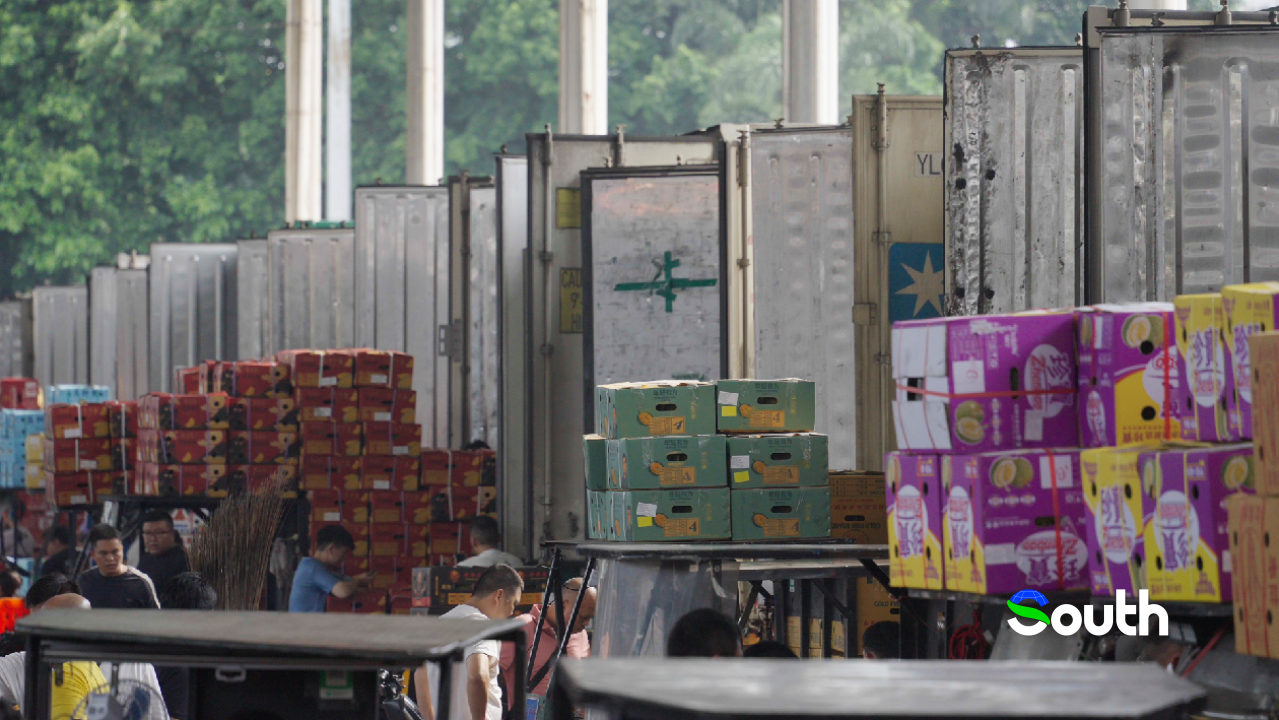
Jiangnonghui Market
Trade between Guangdong and Thailand is built on two-way market access. While durian travels north, Guangdong fruit heads south. In recent years, Zheng has expanded his business into Thailand. Seeing Thailand as a gateway to ASEAN, he partnered with Talaad Thai Market and set up a team to run an imported fruit division.
"Across Southeast Asia, only Vietnam and Thailand have fruit wholesale markets of considerable scale," notes Jay Guo, Senior Vice President of International Market, Talaad Thai Market. "Surrounding countries mostly rely on cold‑storage‑based trading. Merchants from Laos, Myanmar, Cambodia and Malaysia all source goods at our market."
Every May and June, lychees in Guangdong orchards are picked before sunrise. Harvested with branches attached, they are pre‑cooled, packed and flown out the same day. "Shipped by air, they depart today and arrive tomorrow," explains Ling Junlai, General Manager of Fulai Fruits Import-Export Co., Ltd., who has traded at Talaad Thai Market for years.
"Guangdong's role here is not just supplying fruit from its own province. It also coordinates supplies from various producing regions across China. It can procure, consolidate, pack and ship these fruits to Thailand by sea," Guo says. "Once the fruit arrives in Thailand, it is then transported overland to neighboring Southeast Asian countries for distribution."
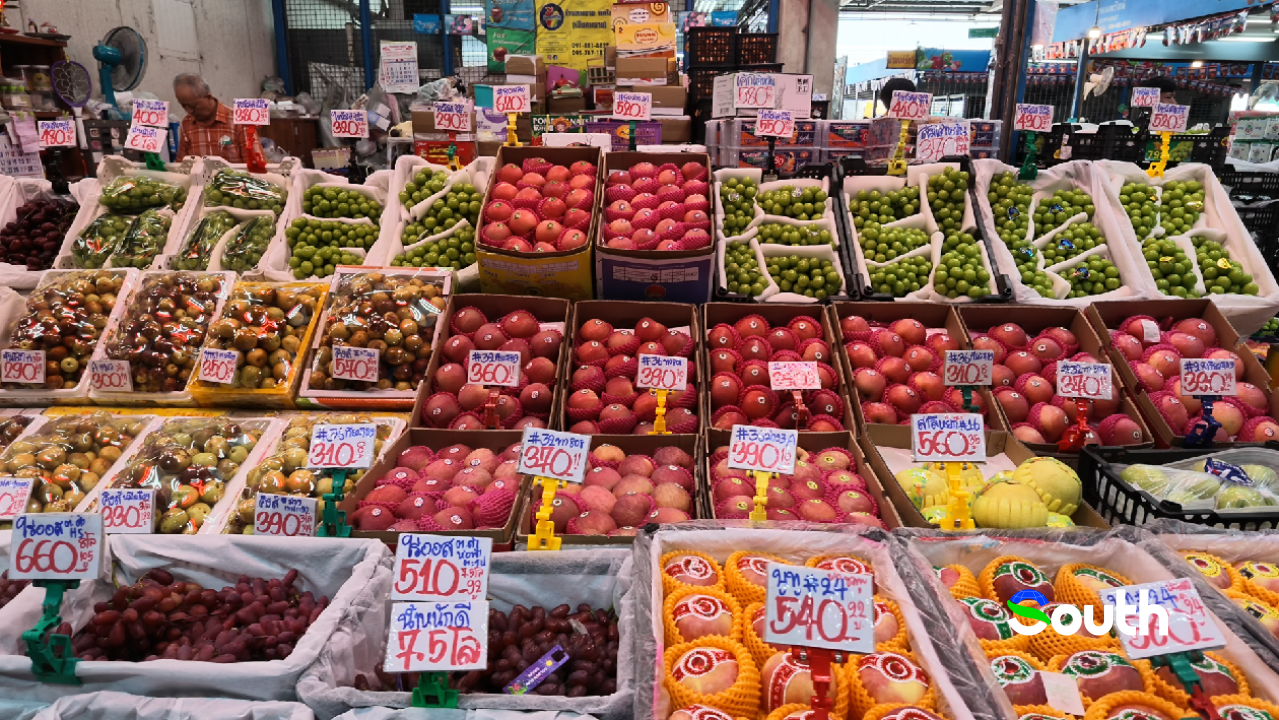
Talaad Thai Market
New tech taking off in Thai farmland
Durian growers face a challenge high up in the canopy. Mature durian trees can grow 15–20 meters tall, with thick, overlapping branches forming a broad umbrella-shaped crown.
"Diseases and pests such as fruit rot, fruit flies, spider mites and aphids used to cause 20–30 percent of durian yield losses every year," says Bridge Liu, International Business Director of XAG.
That has changed in recent years. In 2023, XAG formalized a partnership with Chia Tai in Thailand. Today, drones sweep over the treetops, spraying fine droplets onto the leaves, while ground robots move slowly along the rows doing routine maintenance.
"We combine aerial spraying and ground operations," Liu says. The technology cuts those 20–30 percent losses and lifts yields.
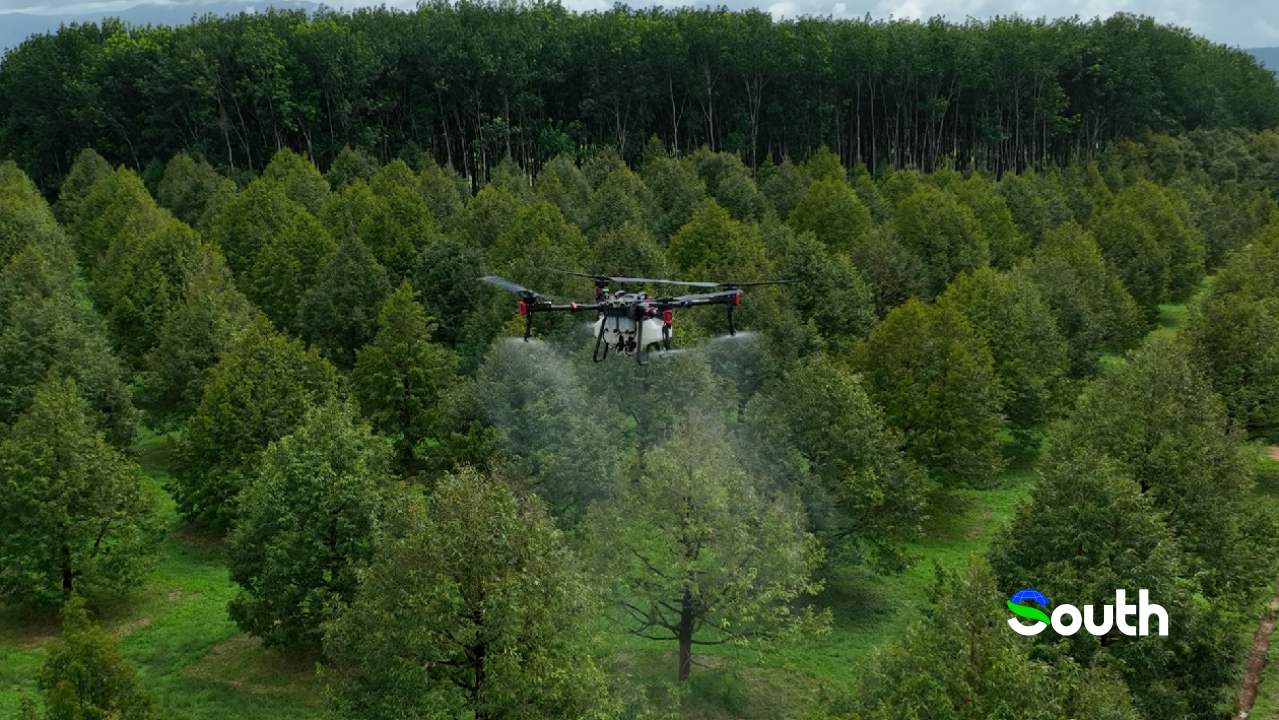
An XAG drone operates in a Thai durian orchard.
The same transformation is underway in rice paddies. "In the past, farmers usually hired workers or service teams to work in the fields," says Narathip Pameta, Service Provider Advisor of Chia Tai Company Limited.
After drones and new techniques were introduced, working hours dropped sharply. "Farmers no longer need to trudge through the fields. Only one or two workers are needed to finish work that once required around 10 people."
The savings go beyond physical labor. "We can schedule spraying and fertilizing and no longer work in the sun all day," he says. Farmers can take on extra service jobs after finishing their own plots. "This creates a new source of income and attracts young people into the industry."
A green manufacturing ecosystem taking root
At BYD's plant in Rayong, electric vehicles move along the assembly line. Blue-light scanners sweep over battery packs and other large, complex parts, building a full 3D image and picking up dimensional errors within seconds. Coordinate measuring machines probe surfaces point by point, checking tight tolerances on sealing faces and motor bearing holes.
The plant is BYD's first overseas passenger vehicle manufacturing base, with a designed annual capacity of 150,000 units. Local staff make up 95 percent of its workforce.
"Before joining BYD, I had no prior experience with this type of work," says Yanawud Rattanachomphu, a young Thai engineer.
Fresh out of university, he is in his first full-time job. "Working for one of Thailand's largest companies makes my family and friends proud."
He has also made friends from China. After work, he says, Thai and Chinese colleagues talk about each other's culture: the Thai staff ask about places to visit in China, and the Chinese ask for Thai food recommendations.
"I plan to travel to Guangdong," he says. "As far as I know, Shenzhen is one of the biggest and fastest-growing economic cities in China. And actually, BYD also has its headquarters in Shenzhen, right?"
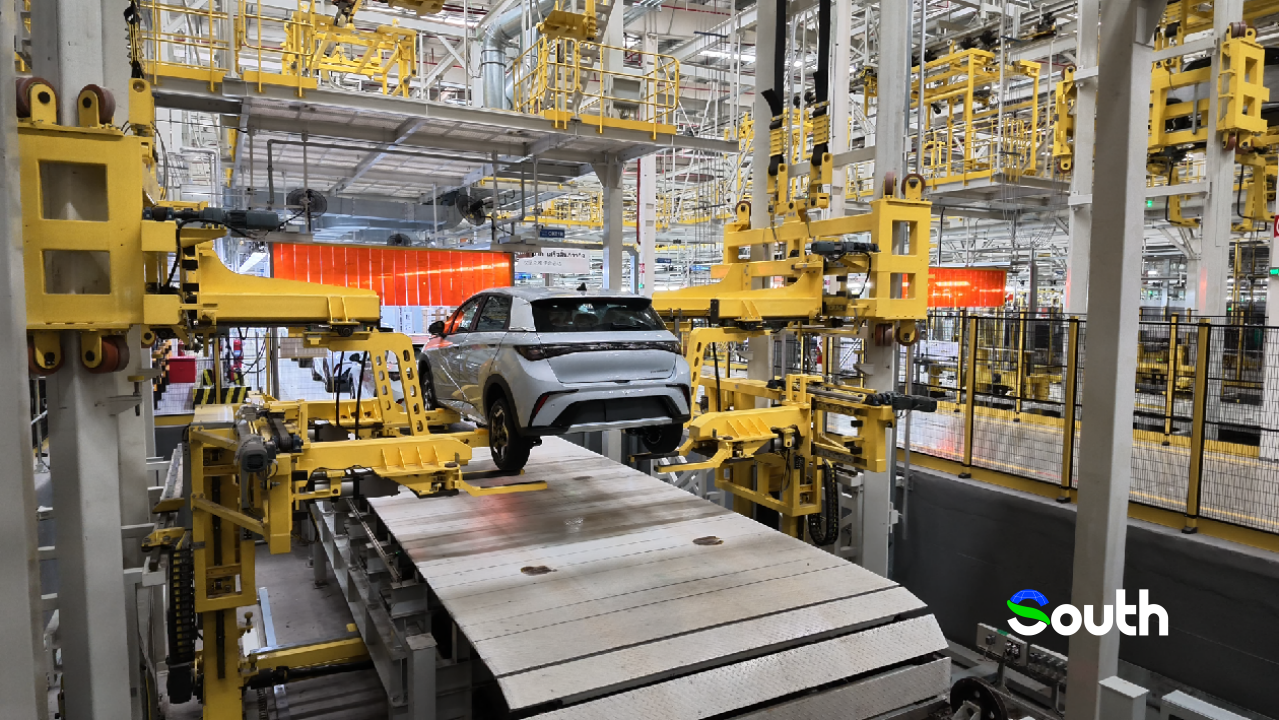
BYD's plant in Rayong, Thailand
Chaowchai Jiemvijid, Member of the Working Committee on China of the Thai Chamber of Commerce and Board of Trade of Thailand, says they hope Chinese enterprises will do more than build factories in Thailand, developing complete supply chains, making use of local labor and succeeding together with the country.
"Guangdong-Thailand cooperation started with simple trade. But over time, it has gone beyond mere commodity-based economic ties, and expanded into agro-processing manufacturing and high-tech industries," notes Liszt Leega, Assistant to the President for Panyapiwat Institute of Management and COO of Siam Think Tank.
"The APEC Economic Leaders' Meeting to be held in Guangdong marks not only a highlight for Asia-Pacific cooperation, but also the start of a new chapter for China and Thailand, as the two countries move from traditional friendly neighbors to pursuing new forms of cooperation in a new era." Leega says that the meeting, with its rule-setting power and platform advantages, could turn shared interests into genuine win-win cooperation.
More:
Guangdong and Singapore: 2,700 kilometers apart, yet "zero distance" | Guangdong Meets APEC ①
Guangdong and Papua New Guinea: Taking roots across the Pacific | Guangdong Meets APEC ②
Guangdong, Russia: Sowing seeds, shaping industry | Guangdong Meets APEC ③

Copyright © Foreign Affairs Office of Guangzhou Municipal Government,
Hong Kong and Macao Affairs Office of Guangzhou Municipal Government All rights reserved.
PRESENTED BY GDTODAY.
粤ICP备09176539号-5
 粤公网安备44010402003415号