


The second session of the 7th Guangzhou Award Seminar on Learning from Urban Innovation: Social inclusion, community well-being and just transition
On September 16, the second session of the 7th Guangzhou Award International Seminars on Learning from Urban Innovation was successfully held. Representatives of urban innovation initiatives from Tianjin, China; Mandaluyong, the Philippines; Bogotá, Colombia; Neuquén, Argentina; and Rabat, Morocco, presented their initiatives and took part in Q&A sessions.
The session focused on how cities can enhance residents' well-being, reduce social inequalities, and ensure that no one is left behind through inclusive policies, community participation, and social innovation. Around this theme, representatives shared their cities' practices and experiences in promoting community engagement, improving public services, and responding to residents' needs.
Tianjin, China
Ecological Protection as a New Livelihood: Transforming Conservation from a Burden into an Opportunity
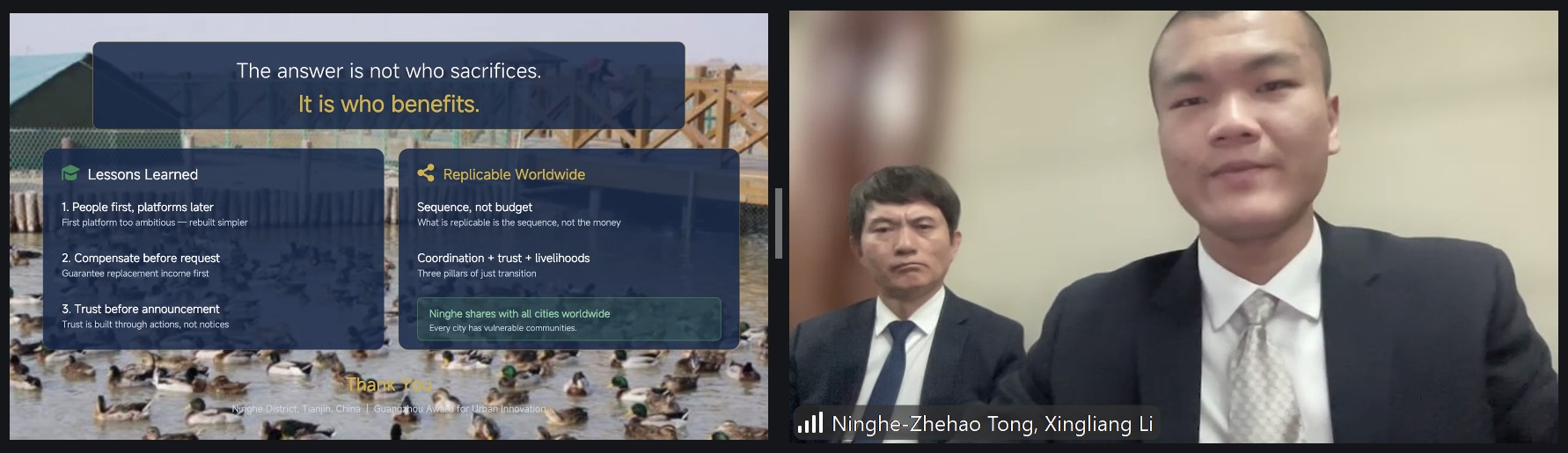
Before 2020, Ninghe District in Tianjin faced a dual challenge: the shrinking of the Qilihai Wetland and the impact on the livelihoods of 26,000 farming households. To move beyond a conservation approach based solely on strict enforcement, Ninghe established an Ecological Environment Protection Committee to strengthen cross-departmental coordination. It also developed new livelihood opportunities, including rice–crab co-cultivation, ecotourism, and volunteer ecological monitoring, enabling residents who bear the costs of ecological protection to also benefit from it. Since the initiative was implemented, biodiversity in the wetland has increased by 47%, with the number of species rising from 335 to 491. Average household incomes have increased fivefold, while the community has also developed 1,000 volunteers. TONG Zhehao, the representative of Ninghe District's initiative, said that the initiative has consistently focused on ensuring that those who bear the costs of ecological protection can truly become beneficiaries of ecological governance.
"How do you convince the farmers who bear the greatest costs of ecological protection?" This question quickly became a focus of discussion after the Q&A session. Faced with practical issues such as farmer relocation and adjustments to production methods, participants further asked how Ninghe balances residents' interests with wetland protection, and to what extent wetland restoration has contributed to improvements in local air quality.
In response, TONG said that Ninghe has assigned liaison officers to villages to communicate with households individually, listen to their concerns, and explain compensation policies. Residents around core protected areas have also been resettled, while space for cultivation, aquaculture, and ecotourism has been retained outside the protected areas. Through compensation, communication, and continued participation, the initiative has achieved zero petitions and zero lawsuits. Regarding improvements in air quality, he said that wetland restoration, together with emissions reductions from surrounding industries and other measures, has contributed to the improvement.
Mandaluyong, the Philippines
Dignified Farewells for All: Extending Urban Services to the Final Stage of Life
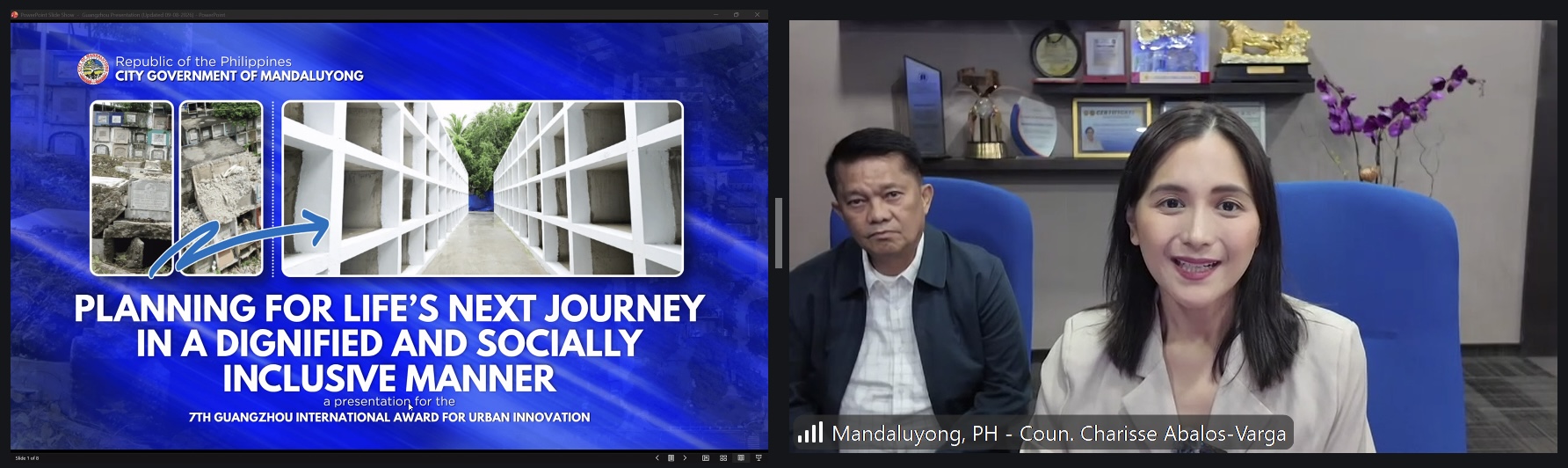
Mandaluyong covers only around 11.26 square kilometers and has a population of approximately 460,000. Around 1,700 people die each year, while the city cemetery covers only 2.54 hectares. Faced with the tension between limited land and insufficient space for traditional burials, Mandaluyong established the Garden of Life Memorial Park, integrating funeral, cremation, and remains storage services. The project improves land-use efficiency through a five-year burial period and vertical columbarium niches, while also providing public services for low-income families. The project has so far provided more than 6,200 columbarium niches and over 3,700 niche-style burial spaces, with related costs reduced by 95% compared with private services. Hon. Charisse Marie A. Abalos-Vargas, City Councilor of Mandaluyong, said that limited resources do not mean limited care; the key is to make more efficient use of existing resources.
"Burial has long been a local tradition. Is it difficult for residents to accept cremation after five years?" Following the project presentation, participants focused on the cultural resistance the initiative initially faced. For this public service innovation involving religious customs and family traditions, they also asked whether the Garden of Life Memorial Park is open to residents of different faiths.
In response, Armando T. Comandao, Department Head of the City Planning and Development Department of Mandaluyong, said that the project team has engaged with communities, families, and religious groups, particularly seeking the understanding and support of religious leaders, to gradually encourage residents to accept new forms of burial. He also emphasized that the Garden of Life Memorial Park is a public facility for all residents and does not differentiate on the basis of religious beliefs.
Bogotá, Colombia
Giving Old Buildings a New Life: Addressing Housing Needs and Heritage Preservation Together
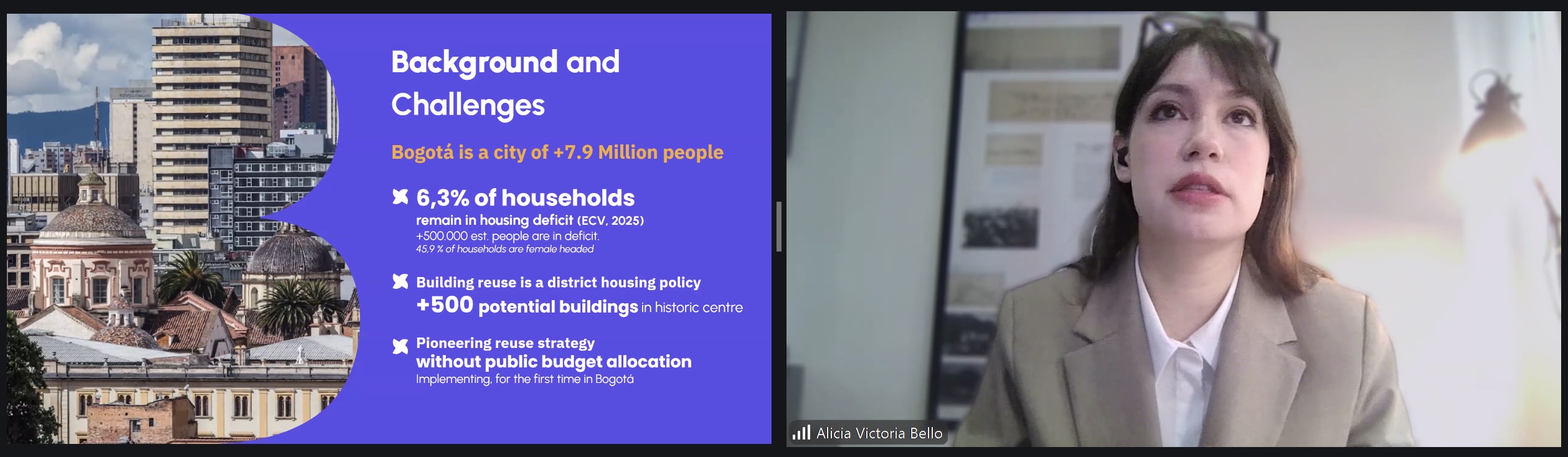
In central Bogotá, growing demand for housing coexists with a significant number of buildings that have remained vacant or underused for years. In July 2024, Bogotá launched the Reúsa y Revitaliza programme, shifting the focus of urban renewal from constructing new housing to making better use of existing spaces. The project connects property owners, private developers, and public institutions through property registration and screening, a virtual marketplace, and project structuring support. An urban renewal enterprise provides technical assessments and feasibility analysis to reduce early-stage redevelopment risks and attract private investment. More than 90 underused properties and over 100 developers and investors have registered, with 10 projects having entered the negotiation stage. Alicia Victoria Bello, Program Coordinator of the Bogotá initiative, said that making better use of existing buildings can address multiple needs at the same time, including housing, heritage preservation, and climate action.
Can a vacant building really be transformed into affordable housing? Around this question, the discussion extended from building reuse to the application of artificial intelligence and housing affordability. Participants asked how AI is specifically being used to identify and assess underused buildings, and how the project can ensure that the housing ultimately created will benefit residents who need it, given that the projects are still at an early stage.
Bello explained that the project is using AI agents to rapidly analyze housing- and building-related documents, identify issues related to property ownership and legal matters, and assist in assessing the feasibility of building reuse, thereby reducing the time required for preliminary information processing. On affordable housing, the project team is working with housing authorities and private companies and using measures such as subsidies to meet the housing needs of different income groups. She also noted that building reuse involves heritage designation, approvals, registration, and other procedures, with individual projects currently typically taking 12 to 36 months to advance.
Neuquén, Argentina
From Being Seen to Taking Part: Supporting Migrants' Integration into City Life
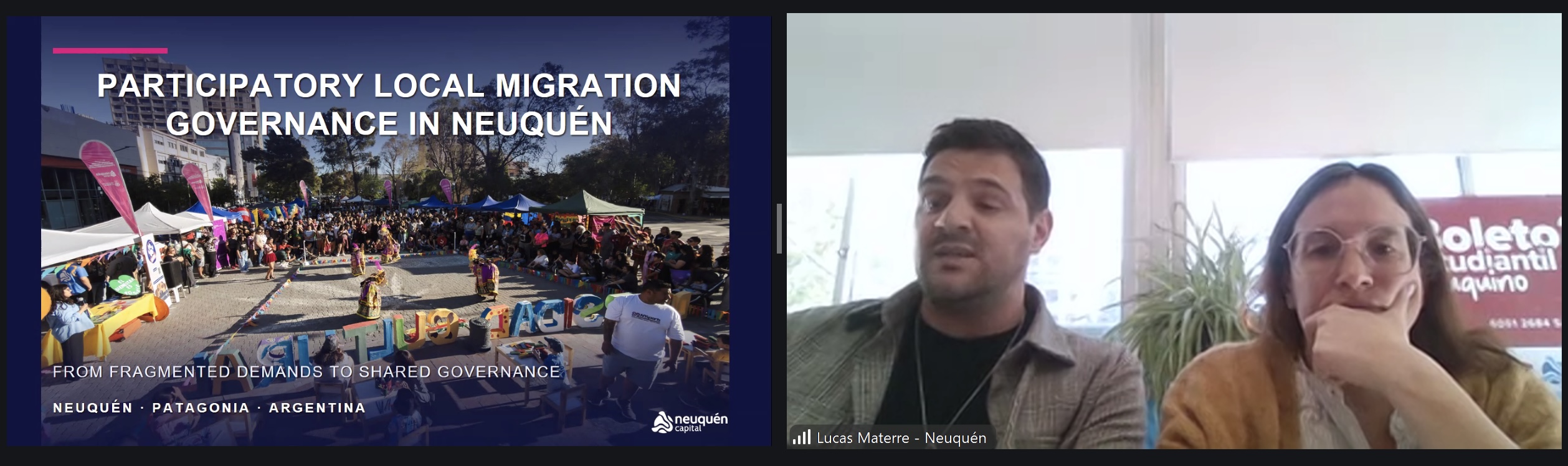
Rapid population growth and increasing population mobility have created new demands in Neuquén, Argentina, as new residents seek access to public services, employment, and urban life. Since 2022, the municipal government has gradually established a migrant governance system that includes a Migrant Assistance Center, a Local Migrants Council, a multicultural public agenda, and administrative data on discrimination. Multilingual service channels connect residents with services covering healthcare, housing, education, employment, and public participation. To date, more than 3,000 people have received consultation and guidance through the municipal service portal, while more than 20,000 questionnaires from 43 communities have provided a basis for related prevention and training. Lucas Gastón Materre, Undersecretary for Human Rights, Diversity, Cultural Pluralism, Gender and Equality of Neuquén, said that migrant governance should not only respond to specific needs, but also enable migrants to become participants and partners in public policymaking.
During the interactive Q&A, participants asked about the main reasons migrants come to Neuquén and how the city ensures that migrants' views are genuinely incorporated into public decision-making. The discussion also explored how cultural diversity events can go beyond cultural representation to become channels for public participation.
In response, Luciana De Giovanetti, Secretary for Human Rights, Institutional Relations and International Cooperation of Neuquén, said that migrants are mainly attracted to the city by employment opportunities in the local oil industry, and that most are able to find jobs. In terms of participation in policymaking, the city places greater emphasis on community needs and cultural values, listening to the views of different groups through mechanisms such as the Local Migrants Council and maintaining regular exchanges with relevant institutions and community organizations. She emphasized that public participation should not remain merely symbolic, but should genuinely influence public services and public decision-making. The Cultural Diversity Fair provides different migrant communities with a space to showcase their traditions, food, and culture, while some migrant festivals have gradually become part of the city's public events.
Rabat, Morocco
"Unbundling" Urban Governance to Make Public Services More Efficient
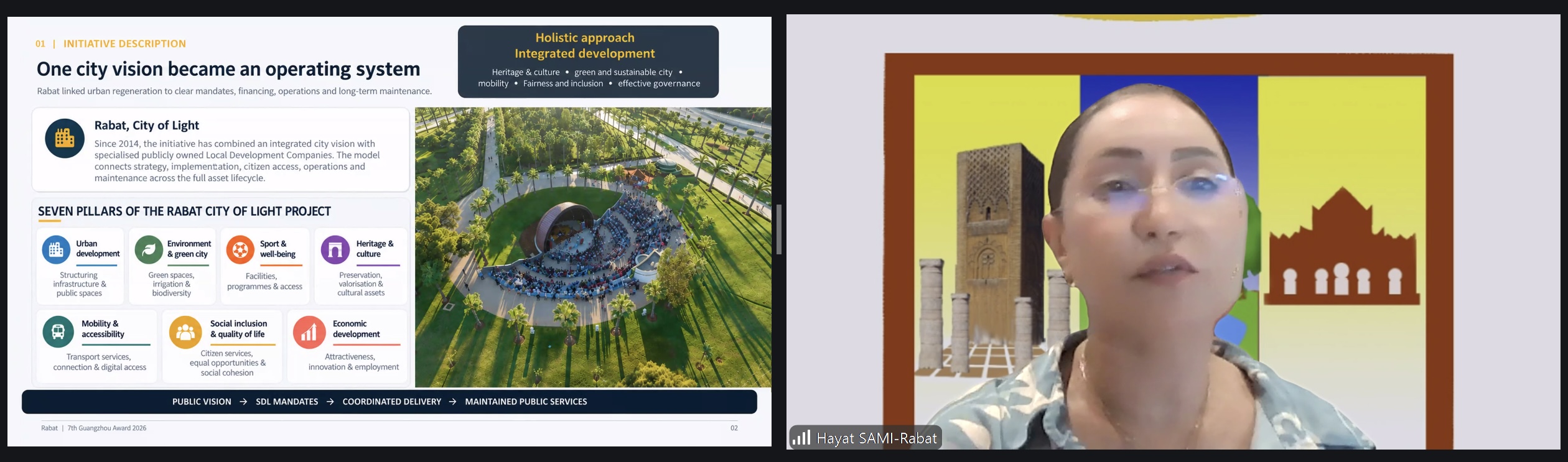
A city must manage roads, green spaces, public transport, and cultural and sports activities at the same time. How can it avoid different departments operating in silos? Rabat's answer has been to redefine responsibilities for managing urban public affairs. Since launching its Sustainable and Inclusive City initiative in 2014, Rabat has established Local Development Companies responsible respectively for urban infrastructure, green spaces, cultural and sports activities, and public transport. With relatively independent legal and financial authority, the government is responsible for strategic decision-making, while specialized companies take responsibility for implementation, thereby clarifying responsibilities and improving efficiency. In recent years, the project has supported the development of 175 community sports grounds. In 2024, these facilities recorded more than 100,000 hours of use, while more than 4,800 hectares of green spaces and green heritage have been improved and maintained. Hayat Sami, Head of the Cooperation and Partnership Department of Rabat, said that this governance structure connects development objectives, financing, implementation, and digital tools, making public services more flexible and efficient.
"After urban affairs are assigned to different specialized companies, how does the government ensure that they continue to work toward the same goals?" Around this governance structure, participants further asked about the composition of the Local Development Companies, the division of responsibilities between the government and the companies, and how the project measures the results of the reform through indicators such as public facility utilization rates. As the discussion continued, issues including cost efficiency and resource recycling were also raised.
In response, Sami explained that staff at the Local Development Companies mainly come from the municipal government, while additional professionals can be recruited according to operational needs. Government departments are responsible for public policies and strategic direction, while specialized companies undertake implementation. The project assesses service performance through indicators such as the use of public spaces, sports facilities, parks, and public transport, while using digital tools and reclaimed water to reduce operating costs. She said that restructuring the governance structure is not simply about handing public affairs over to companies, but about enabling different actors to play their respective roles on the basis of clearly defined public responsibilities.
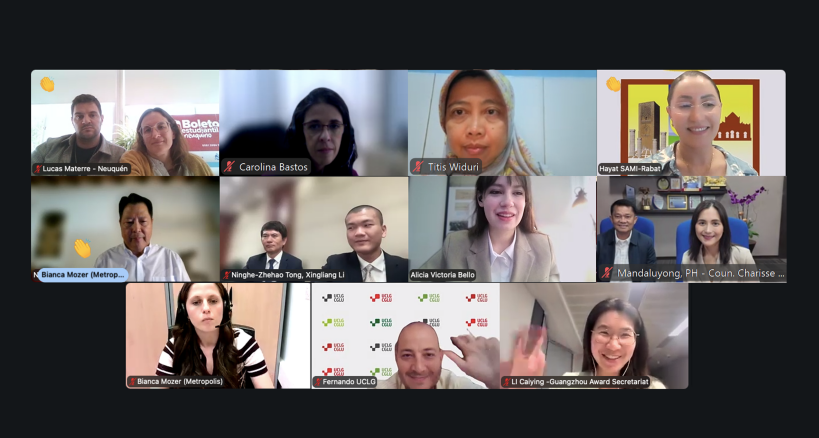
"The five cities responded to the real-world needs of social inclusion and just transition from different perspectives," said Nicholas You, International Advisor of the Guangzhou Award and moderator of the seminar, as the session drew to a close. He noted that from breaking down departmental silos and developing more efficient governance models to enabling residents and other stakeholders to participate in project decision-making, these cases demonstrate a common direction in urban governance innovation: identifying residents' genuine needs first, then using technology and innovative approaches to respond to those needs, making public services more responsive to residents while enabling beneficiaries to become important participants in urban governance.

Copyright © Foreign Affairs Office of Guangzhou Municipal Government,
Hong Kong and Macao Affairs Office of Guangzhou Municipal Government All rights reserved.
PRESENTED BY GDTODAY.
粤ICP备09176539号-5
 粤公网安备44010402003415号